Lost Battalion of Tet by Charles A Krohn
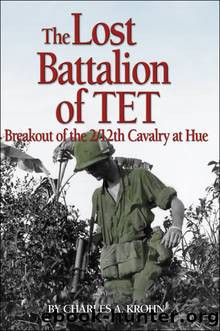
Author:Charles A Krohn [Krohn, Charles A.]
Language: eng
Format: epub
ISBN: 9781612512075
Publisher: Naval Institute Press
Chapter 17
ARTILLERY FIASCO
When the ammunition finally reached our artillery battery at six that evening at PK-17, Jeffries called for fire missions. He was sitting in a foxhole a few feet from mine near the center of our perimeter. He was told that only five hundred rounds had been brought in with the battery. Additional ammo was supposed to be given to us immediately, but was inexplicably delayed until next morning. But five hundred rounds were a lot better than nothing. âThey were the best five hundred rounds I have ever fired,â Jeffries remembers. Sweet and I agreed. We might not survive for another twenty-four hours, but at least we would make it through the night. It wasnât glorious, but we made it. As we fought off attacks, we heard that PK-17 was being rocketed. Battery C even took some hits. We knew that the NVA had their range, because PK-17 had taken a direct rocket hit earlier in the afternoon. It killed one and wounded seven.
Not a single round of the five hundred was wasted or expended needlessly. Targets were zeroed in close to the east and west sides of our perimeter only, however, partly to save ammunition, partly for safetyâs sake.
Army doctrine calls for massed artillery fires to support both offensive and defensive operations. If we had one thing going for us in Vietnam, it was all the artillery we wanted and then some. It was everywhere, and normally no mission was too small for fire. We had so much artillery that we used to dream up missions just to keep the guns hot. The supply was inexhaustible. Just how generous the 1st Air Cav was with firepower can be gleaned from a single example recorded in the division newspaper, Cavalair, in an article bylined by Specialist 5 Don Graham, one of the paperâs reporters. It has to do with an episode that found four 2/12th Cav soldiers pinned down by a single sniper in the Que Son Valley near LZ Ross: âProtected by the rice paddy dike,â Graham reported, âthe U.S. soldiers watched three air strikes, helicopter rocket runs, and more than one thousand rounds of artillery pour down on the enemy positions.â
The four cavalrymen took advantage of the spectacular firepower demonstration to crawl back from the dike. Safely, they rejoined their unit just twenty-five yards away. It probably cost the U.S. taxpayers several hundred thousand dollars to deliver the ordnance on the target, but who can argue it was not worth it?
When our attack into TFP was staged without any artillery, the idea was so improbable that we couldnât fully grasp the significance until after we were surrounded.
Hereâs how it should have happened: First, we should have used the artillery to screen our attack by firing smoke rounds into the woods, obscuring the enemyâs vision. Later, as we mounted the attack and started to move across the open field, we would have requested high explosive artillery shells to be fired into NVA positions, making them keep their heads down.
Download
This site does not store any files on its server. We only index and link to content provided by other sites. Please contact the content providers to delete copyright contents if any and email us, we'll remove relevant links or contents immediately.
| Africa | Americas |
| Arctic & Antarctica | Asia |
| Australia & Oceania | Europe |
| Middle East | Russia |
| United States | World |
| Ancient Civilizations | Military |
| Historical Study & Educational Resources |
The Radium Girls by Kate Moore(12095)
100 Deadly Skills by Clint Emerson(4974)
Rise and Kill First by Ronen Bergman(4839)
The Templars by Dan Jones(4739)
The Doomsday Machine by Daniel Ellsberg(4556)
The Rape of Nanking by Iris Chang(4262)
Killing England by Bill O'Reilly(4042)
Stalin by Stephen Kotkin(4007)
Hitler in Los Angeles by Steven J. Ross(3981)
12 Strong by Doug Stanton(3581)
Hitler's Monsters by Eric Kurlander(3386)
The Code Book by Simon Singh(3252)
Blood and Sand by Alex Von Tunzelmann(3240)
Darkest Hour by Anthony McCarten(3161)
The Art of War Visualized by Jessica Hagy(3044)
Hitler's Flying Saucers: A Guide to German Flying Discs of the Second World War by Stevens Henry(2777)
Babylon's Ark by Lawrence Anthony(2719)
Tobruk by Peter Fitzsimons(2559)
The Second World Wars by Victor Davis Hanson(2554)
